
The future of national security will be shaped not only by who develops the most advanced technologies, but by who can put trusted information to work when and where it matters most.
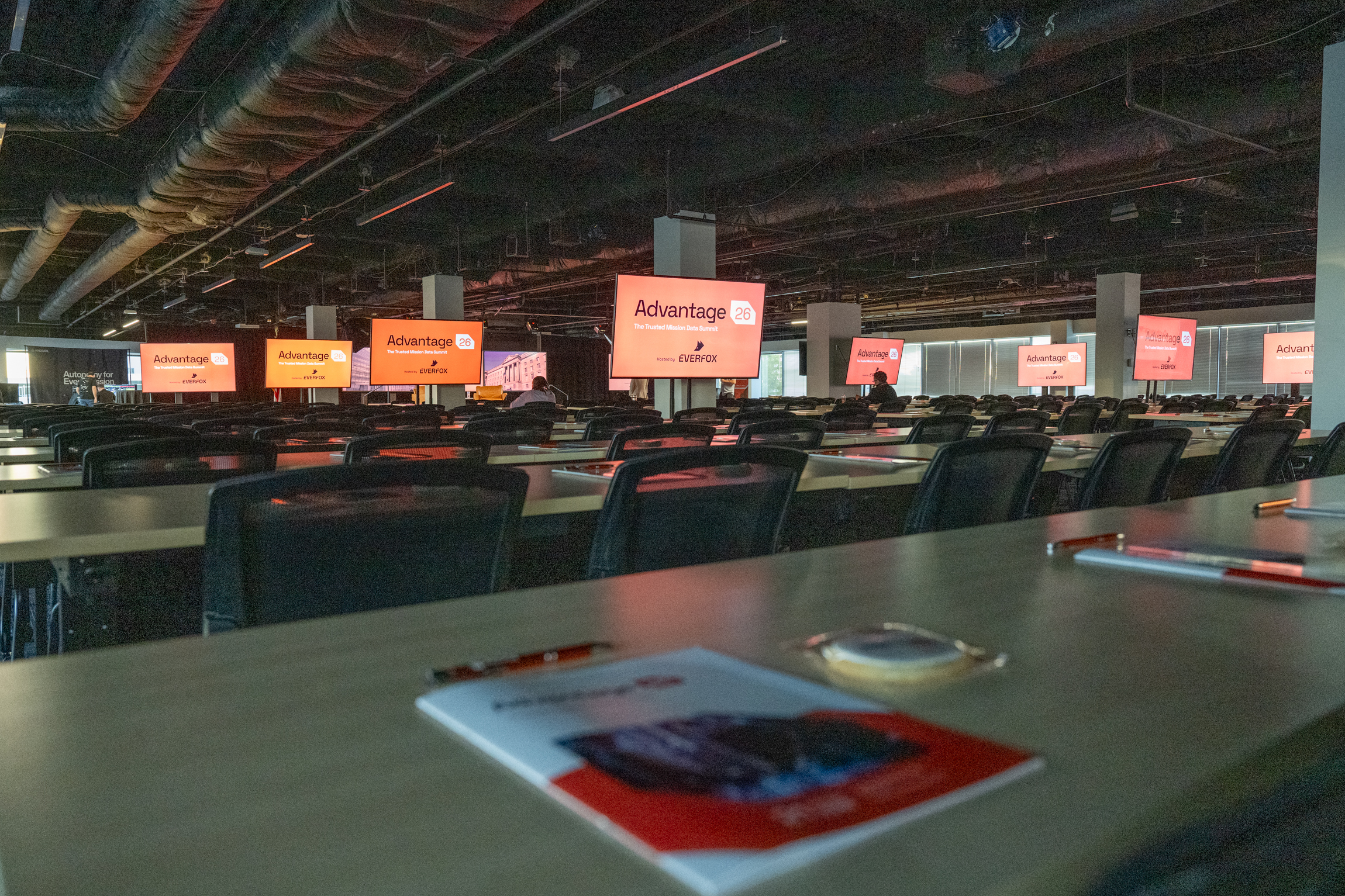
That was the central theme of Advantage 26: The Trusted Mission Data Summit, hosted by Everfox on October 21 in Reston, Virginia.
The event brought together leaders from government, defense, intelligence and private industry to explore how rapidly advancing technologies, evolving threats and increasingly complex operational environments are reshaping the future of defense.
Across keynote presentations, executive conversations, panel discussions and technology demonstrations, one message emerged: achieving mission advantage requires more than collecting information or deploying new technology. It requires the ability to securely access, move and govern trusted data across systems, security classifications, organizations and operational environments.
From artificial intelligence and coalition interoperability to the defense industrial base and tactical edge, the discussions highlighted both the opportunities and challenges facing modern defense organizations.
A Changing Battlefield Demands a New Approach
Advantage 26 opened with remarks from David Wajsgras, Chairman and CEO of Everfox, who described an increasingly complex global security environment.
From strategic competition with China and ongoing conflict in Europe to evolving threats against critical infrastructure and global supply chains, defense organizations face simultaneous challenges across multiple domains.
While geopolitical competition is not new, the pace of technological advancement is fundamentally changing how these challenges unfold.
“Technology, broadly speaking, has always shaped the fight. Think about the longbow from hundreds of years ago. The side that has harnessed new technology first and most effectively is almost always on the winning side of the equation,” Wajsgras said.
He pointed to Ukraine as an example of how inexpensive autonomous systems and rapidly evolving technologies are changing the economics and tactics of warfare.
These developments are placing new demands on military organizations. Information must move faster, decisions must be made with greater confidence, and capabilities must adapt to threats that evolve in weeks rather than years.
The result is an increasingly important strategic requirement: decision advantage.
But as speakers throughout Advantage 26 emphasized, faster decisions are only valuable when they are based on information that can be trusted.
Trusted Mission Data: The Foundation for Decision Advantage
Modern defense organizations generate enormous volumes of information from sensors, intelligence systems, operational platforms and distributed networks.
The challenge is no longer simply collecting more data. It is determining which information can be trusted, making it available to authorized users and systems, and translating it into meaningful operational decisions.
Clarence Hinton, Everfox’s Chief Strategy and Corporate Development Officer, described the shift during the summit.
“Quantity of data is no longer the primary problem. We have access to very large volumes of data from disparate places. What’s really critical for us is being able to use the data that we have and make sense of it in real time to actually drive the mission forward toward mission success,” Hinton said.
Artificial intelligence has the potential to dramatically accelerate this process, analyzing information at a scale and speed beyond human capacity.
However, AI also introduces new risks when the information entering a model is incomplete, manipulated, outdated or unreliable.
“Inputting bad data into an AI model results in bad decisions coming out at massive scale and with great rapidity,” Hinton explained.
The implications extend beyond AI. Whether information supports an intelligence assessment, a coalition operation, an autonomous system or a command decision, its value depends on its integrity, accessibility and appropriate protection.
The conversations at Advantage 26 reinforced a fundamental principle: trusted mission data must be secured, moved and governed throughout its operational lifecycle.
From Artificial Intelligence to Super Intelligence: Preparing for What’s Next
Artificial intelligence was a major focus of Advantage 26, with discussions exploring how emerging models, agents and AI-enabled systems can help defense organizations improve decision-making and operational effectiveness.
Sessions featuring leaders from organizations including Anthropic, OpenAI and NVIDIA examined the opportunities associated with bringing advanced AI into national security environments.
The conversations also looked beyond today’s AI capabilities to the potential emergence of super intelligence (SI), a future stage of AI development in which systems could surpass human intelligence across a broad range of cognitive tasks.
As AI evolves toward increasingly autonomous and potentially superintelligent systems, the importance of trusted mission data will only grow. More capable systems may be able to process information and act at unprecedented speed, but their effectiveness will still depend on the integrity, security and governance of the data they access and use.
The challenge is no longer limited to demonstrating what AI can do. It is determining how to deploy these capabilities in environments where security, reliability, access controls and mission requirements are nonnegotiable.
AI systems need access to relevant information to deliver useful outcomes. Yet much of the information required for defense missions exists across different security classifications, cloud environments, organizations and operational networks.
Connecting AI to that information securely is essential to moving beyond experimentation.
The emergence of agentic AI adds another dimension. Systems capable of performing increasingly complex tasks introduce new questions about what information they can access, what actions they can take and how their activities should be controlled.
These discussions underscored that AI adoption and data security cannot be treated as separate initiatives.
For AI to deliver meaningful mission advantage, organizations must establish confidence not only in the technology, but also in the data, access and governance mechanisms supporting it.
Securing Collaboration Across Coalitions and Mission Partners
Another important theme was the growing need for trusted information sharing among allied nations, government agencies and mission partners.
Modern military operations increasingly depend on collaboration across organizational and national boundaries. Yet the information required to support those operations often resides in systems operating at different classification levels, under different security policies and within different national environments.
The challenge is particularly significant for coalition operations, where allies must balance interoperability with national sovereignty and control over sensitive information.
During the summit, Charles Forte, former Chief Information Officer of the UK Ministry of Defence, joined Clarence Hinton for a discussion on securing the coalition.
Their session explored the challenges of sharing trusted information across allied environments while maintaining appropriate security and control.
The broader takeaway was clear: protecting sensitive data and enabling collaboration are not competing objectives.
Mission effectiveness increasingly depends on achieving both.
This requires approaches that allow information to move securely between authorized users, systems and partners without weakening the security boundaries designed to protect it.
As multinational operations become more integrated, trusted information exchange will be essential to helping coalition partners operate with a shared understanding of rapidly changing conditions.
Building the Modern Defense Industrial Base
The changing nature of warfare is also reshaping the relationship between government, established defense contractors and emerging technology companies.
A panel featuring leaders from across the defense industrial base, including representatives of Anduril and Parsons, examined how new technologies, changing acquisition expectations and the growing importance of commercial innovation are influencing the development and delivery of defense capabilities.
The ability to adapt quickly is becoming as important as the sophistication of the technologies themselves.
However, innovation alone does not create operational advantage.
New capabilities must work with existing mission systems, operate within demanding security environments and integrate with technologies developed by other organizations.
That creates a growing need for collaboration across the defense technology ecosystem.
No single company, platform or technology provider can address every requirement associated with modern mission operations.
Instead, achieving mission advantage increasingly depends on bringing complementary capabilities together, connecting them securely and making them practical to deploy.
The summit also highlighted the importance of industry collaboration in accelerating innovation and helping defense organizations move from emerging technologies to mission-ready capabilities.
Extending Trusted Data to the Tactical Edge
The importance of trusted information becomes even more pronounced at the tactical edge.
Military personnel and autonomous systems often operate in environments with limited connectivity, contested communications and rapidly changing operational conditions.
A panel featuring representatives from Palantir, Armada and Everfox examined the challenges of connecting data, technology and mission capabilities in these demanding environments.
The tactical edge illustrates why information availability and information protection must be addressed together.
Data needs to reach the people and systems that can act on it, even when connectivity is constrained and operational conditions are unpredictable.
At the same time, organizations must maintain confidence that sensitive information is protected and accessible only to authorized recipients.
The discussion reinforced that mission advantage depends on more than the performance of an individual application, sensor or platform.
It depends on how effectively information can move across the broader operational environment.
Addressing Insider Risk and the Human Dimension
While much of the discussion focused on emerging technology, Advantage 26 also examined the human and organizational risks associated with increasingly connected mission environments.
William Evanina, former Director of the National Counterintelligence and Security Center, addressed the importance of insider risk and the challenges organizations face in protecting sensitive information.
As more people, systems and partners gain access to mission-critical data, organizations must account for risks that extend beyond external cyber threats.
These include inappropriate access, misuse of sensitive information and vulnerabilities introduced through human behavior or compromised identities.
Effective data protection therefore requires more than securing networks and technology infrastructure.
It also requires appropriate governance over who can access information, how it can be used and how organizations identify potentially harmful activity.
The broader lesson is that trusted mission data depends on protecting information throughout its lifecycle, including the people and systems interacting with it.
Operationalizing Trusted Mission Data
A recurring question throughout Advantage 26 was how organizations can move from promising technologies and strategic concepts to capabilities that deliver measurable operational value.
A panel moderated by Costa Saab brought together senior defense and government perspectives to examine the practical challenges associated with operationalizing trusted mission data.
The discussion addressed the realities of deploying new technologies within complex mission environments, where legacy infrastructure, security requirements, organizational boundaries and operational demands must all be considered.
Related conversations explored the infrastructure required to support AI-enabled operations and the importance of connecting complementary technologies across the broader defense ecosystem.
Together, these sessions highlighted a critical distinction between technological innovation and mission outcomes.
The value of advanced technology is ultimately determined by whether it can be deployed securely, integrated effectively and used by mission teams when it matters.
Achieving that outcome requires collaboration among government, defense technology companies, AI innovators, cloud providers and infrastructure partners.
The Path Forward: From Trusted Data to Mission Advantage
Advantage 26 highlighted an important shift in how defense organizations must think about information and technology.
The challenge is no longer simply generating more data, deploying more advanced AI or connecting more systems.
It is bringing these capabilities together in ways that enable trusted information to support faster, more confident decisions.
Across the summit’s discussions, several priorities emerged: ensuring the integrity of data supporting AI and autonomous systems; enabling secure information sharing across classifications and coalition partners; protecting sensitive information from external and insider threats; and connecting emerging technologies with the infrastructure and operational systems required to put them to work.
These challenges are interconnected.
AI cannot deliver its full potential without trusted information. Coalition operations cannot function effectively without secure collaboration. And technological innovation cannot create mission advantage unless capabilities can be integrated and deployed where they are needed.
As Wajsgras emphasized in his opening remarks:
“Wars and strategic competition will be won and lost by who can get the right data to the right people and systems at the right time and do it securely.”
That message captured the central theme of Advantage 26 and the opportunity ahead.
The future runs on trusted mission data. And the ability to secure, move and govern that data will be fundamental to achieving mission advantage.
About Advantage 26
Hosted by Everfox, Advantage 26: The Trusted Mission Data Summit brought together government, defense, intelligence and industry leaders to explore how trusted information, advanced technology and secure collaboration can accelerate mission advantage.