


Critical data needs to move, sensor feeds, telemetry, operational information and mission data need to reach the systems, analysts and decision-makers that depend on them, often at speed.
But in high-threat environments, moving information can also create risk. For protected, classified or high-value systems, preventing traffic from flowing back into the source environment can be just as important as getting data out. That is where Data Diodes come in.
Data Diodes provide hardware-enforced, one-way data transfer, creating a physical boundary that allows information to move in one direction while preventing a network return path. For organizations operating in high-consequence environments, diodes can provide a level of assurance that software controls alone cannot deliver. However, not every one-way transfer requirement is the same.
Sometimes enforcing direction is enough. In other environments, organizations also need greater control over what is permitted to move forward. And for some missions, information must move securely in both directions between security domains.
Understanding those differences is critical to choosing the right security architecture.
When is a Data Diode the Right Choice?
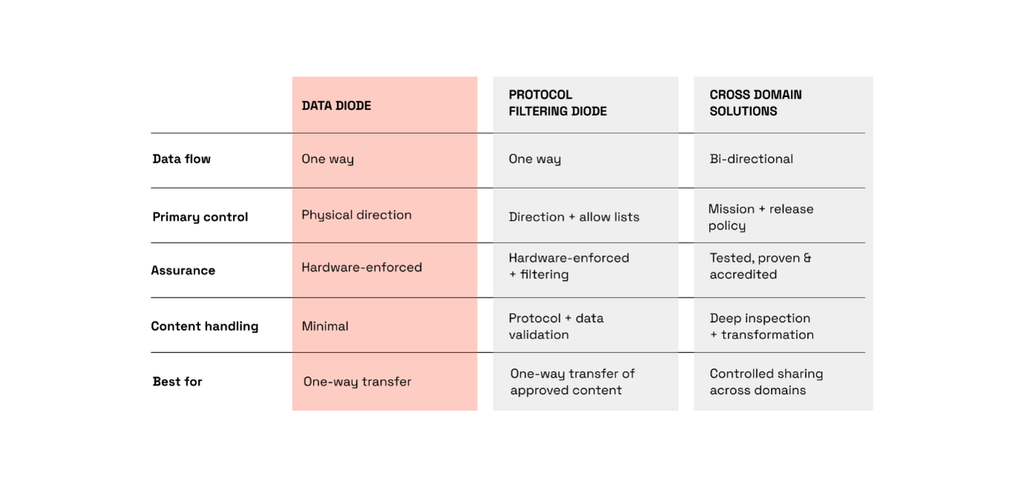
A Data Diode is designed for environments where the fundamental requirement is simple: Data needs to move forward, and nothing can move back.
By physically enforcing the direction of transfer, a Data Diode removes the network return path and helps protect the source environment from reverse traffic, reach-back and unintended inbound access.
That makes Data Diodes particularly valuable where organizations need to:
- Move information out of classified, protected or high-value networks
- Prevent any return path into the source environment
- Transfer sensor, telemetry or operational data at speed
- Reduce the attack surface through hardware-enforced separation
The key consideration is direction. If the security requirement is to guarantee that data flows one way only, a Data Diode may provide the level of protection the environment requires.
What if You Also Need to Control What Moves Forward?
For some high-threat environments, direction alone is not enough. You may know that information must travel in only one direction, but you may also need to restrict the protocols, data or traffic permitted to cross the boundary.
A Protocol Filtering Diode (PFD) adds that additional level of control.
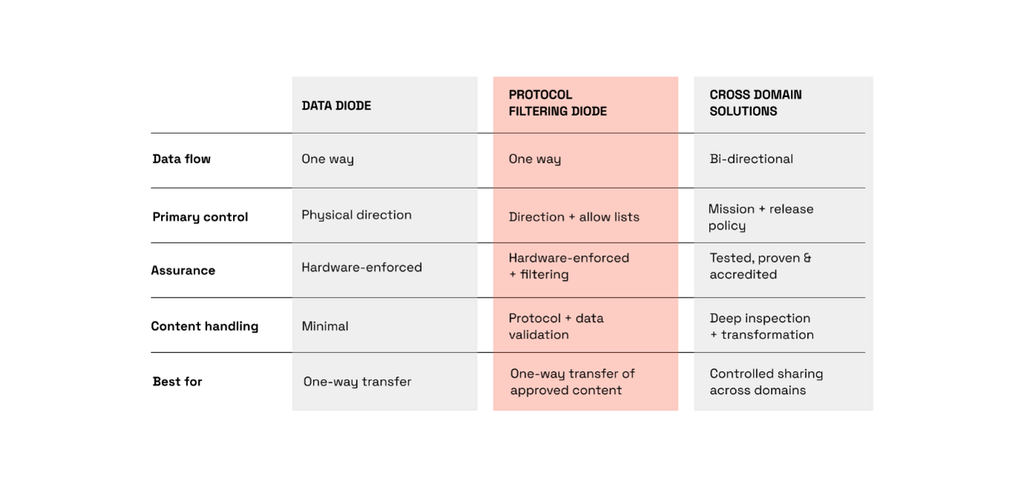
Similar to a Data Diode, a PFD maintains hardware-enforced one-way flow. However, it also applies filtering and validation so that only expected or approved traffic is allowed forward.
This makes a PFD better suited to environments where teams need to:
- makes a PFD better suited to environments where teams need to:
- Maintain guaranteed one-way transfer
- Apply protocol allow lists
- Control the types of information permitted to cross the boundary
- Validate data before it reaches the destination
- Reduce exposure to unexpected or malformed traffic
The distinction is important:
1. A Data Diode controls the direction of transfer
2. A Protocol Filtering Diode controls the direction and adds greater control over what is allowed through
What If One-Way Transfer Isn’t Enough?
Some missions require secure information flow in both directions between security domains, going beyond what one-way transfer can support. That introduces a different set of requirements.
Rather than simply enforcing direction, organizations may need to inspect information more deeply, transform content, apply release policies and determine what information is permitted to move from one security domain to another.
This is where Cross Domain Solutions such as Everfox Data Guard and High Speed Verifier (HSV) come into the picture.
Cross Domain Solutions support controlled information sharing by applying deeper content inspection, transformation and mission-specific release policy.
They are best suited to operations requiring high-assurance, bidirectional information exchange across security domains with policy-based control over what moves between them.

Start With the Security Outcome
The question shouldn’t begin with a product, it should begin with what your mission needs to achieve:
- Do you need to guarantee that nothing can flow back? Start with an Everfox Data Diode.
- Do you need one-way transfer, but also greater control over what is allowed forward? Consider an Everfox Protocol Filtering Diode.
- Does information need to move securely in both directions between different security domains? A Cross Domain Solution may be the right fit.
The difference comes down to three questions:
1. Can anything come back?
2. What is allowed forward?
3. Does information need to move both ways?
Answering those questions can help determine the level of assurance, filtering and policy enforcement required.
Not every mission needs the same security architecture, find the right level of protection for your environment.
Everfox’s Data Diodes for High-Threat Networks provides a quick, visual comparison of Data Diodes, Protocol Filtering Diodes and Cross Domain Solutions, helping security and mission teams identify which approach best aligns with their information-flow requirements.